
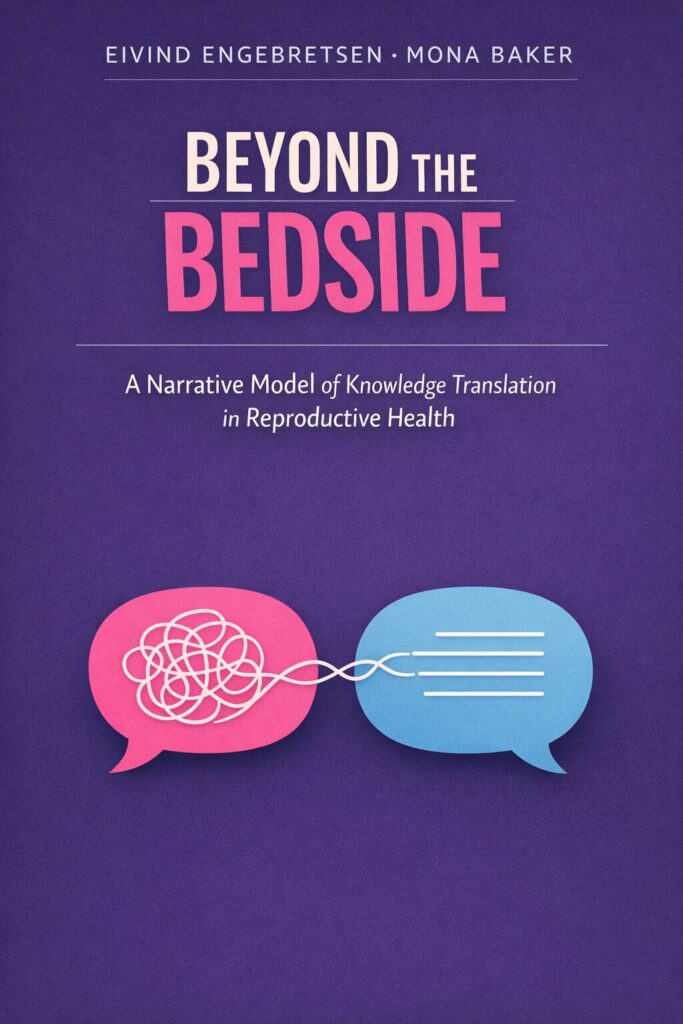
A Narrative Model of Knowledge Translation in Reproductive Health
Eivind Engebretsen & Mona Baker
Cambridge University Press, 2026 (forthcoming)
How does medical knowledge travel from scientific research to clinical practice, public policy, and political debate?
In February 2024, the Alabama Supreme Court ruled that frozen embryos created through IVF could be considered “children” under state law. Within days, fertility clinics across the state suspended treatment. Doctors suddenly faced a new question: could routine medical practices—freezing embryos, testing them, even discarding them—now expose them to criminal liability? What had shifted was not the evidence, but the story told about it. By redefining embryos as legal persons rather than elements of a medical process, the ruling translated embryological knowledge into a new legal narrative. IVF was no longer framed as a reproductive technology governed by clinical guidelines and risk management, but as a matter of child protection. Clinicians were forced to translate that narrative back into practice, and established protocols suddenly no longer aligned with the story the law was telling about embryos, responsibility, and risk.
This moment captures a central insight of Beyond the Bedside: medical knowledge does not travel through society as neutral facts. As it moves from research labs to clinical guidelines, courtrooms, political debates, and media coverage, it is continually interpreted, reframed, and retold. Evidence becomes meaningful through the stories that are told about it.
Beyond the Clinical Encounter
Narrative medicine has traditionally focused on the stories exchanged between doctor and patient—the personal narratives through which illness is understood and care becomes humane.
But the influence of narrative extends far beyond the bedside.
Scientific papers, systematic reviews, policy reports, clinical guidelines, legal rulings, and media debates all rely on narrative structures to organize evidence and guide decisions. These texts do not simply present facts; they frame problems, assign responsibility, and suggest particular courses of action. In doing so, they shape how medical knowledge is interpreted and applied in the world.
Beyond the Bedside argues that narrativity is not an optional supplement to scientific medicine—it is one of the central mechanisms through which medical knowledge is produced, communicated, and translated into practice.
Rethinking Knowledge Translation
In contemporary healthcare, knowledge translation refers to the effort to move research findings into clinical practice and public policy—often described as translating discoveries from “bench to bedside.” Yet this process is usually imagined as a technical transfer of evidence from scientists to practitioners.
In reality, the movement of knowledge is far more interpretive. Research findings are repeatedly reframed as they pass through different texts and institutions: grant proposals, journal articles, systematic reviews, clinical guidelines, policy briefs, and media reports. Each stage involves choices about emphasis, interpretation, and meaning. Evidence does not simply travel—it is renarrated.
Medicine in an Era of Controversy
The importance of narrative becomes especially clear in areas where medical evidence intersects with deeply contested ethical and political questions.
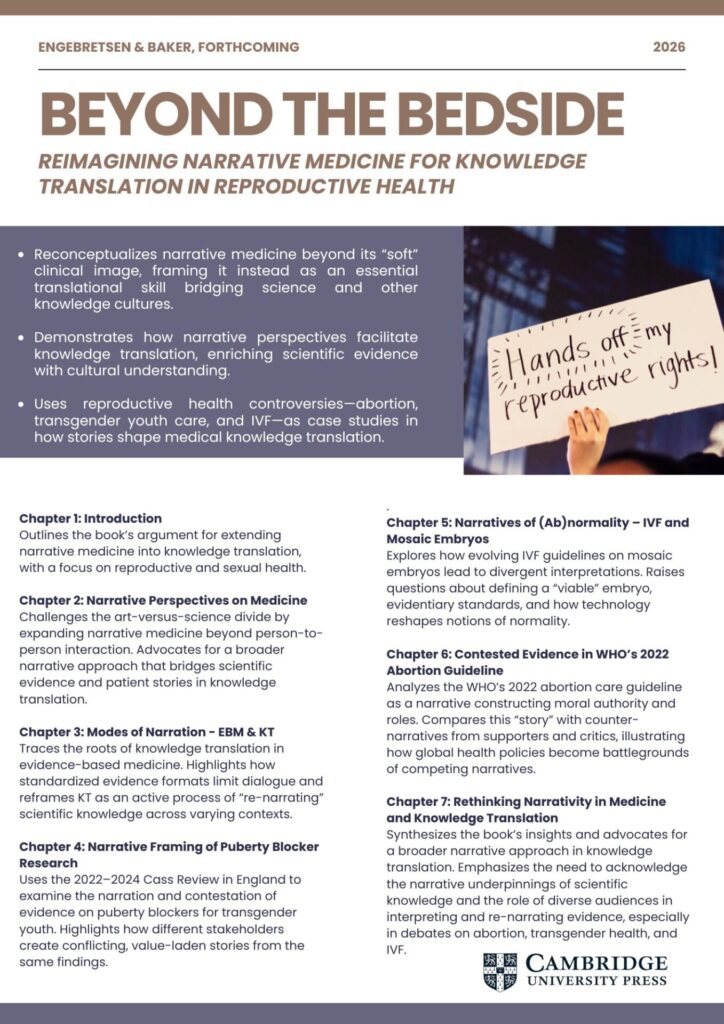
The book explores three major debates in reproductive and sexual health:
- Puberty blockers for transgender youth
- Genomic testing and embryo selection in IVF
- Abortion care and global health policy
In each case, disagreements are rarely about data alone. Instead, they reflect competing narratives about risk, autonomy, protection, responsibility, and the meaning of evidence itself. The same scientific findings can be framed as evidence of progress, grounds for caution, or justification for restriction—depending on the story in which they are embedded.
Key Themes
Narrative and science
Scientific knowledge is always communicated through narrative structures that shape how evidence is interpreted.
The politics of evidence
Medical debates are often conflicts between competing narratives about values, risk, and responsibility.
Knowledge translation
Moving research into practice is not simply a technical process but an interpretive and narrative one.
Reproductive health controversies
The book examines debates on puberty blockers, IVF genomics, and abortion as case studies of narrative conflict in medicine.
Deep knowledge translation
The book proposes a more reflexive model of translating evidence—one that recognizes narrative as constitutive of medical knowledge rather than incidental to it.

Leave a Reply