
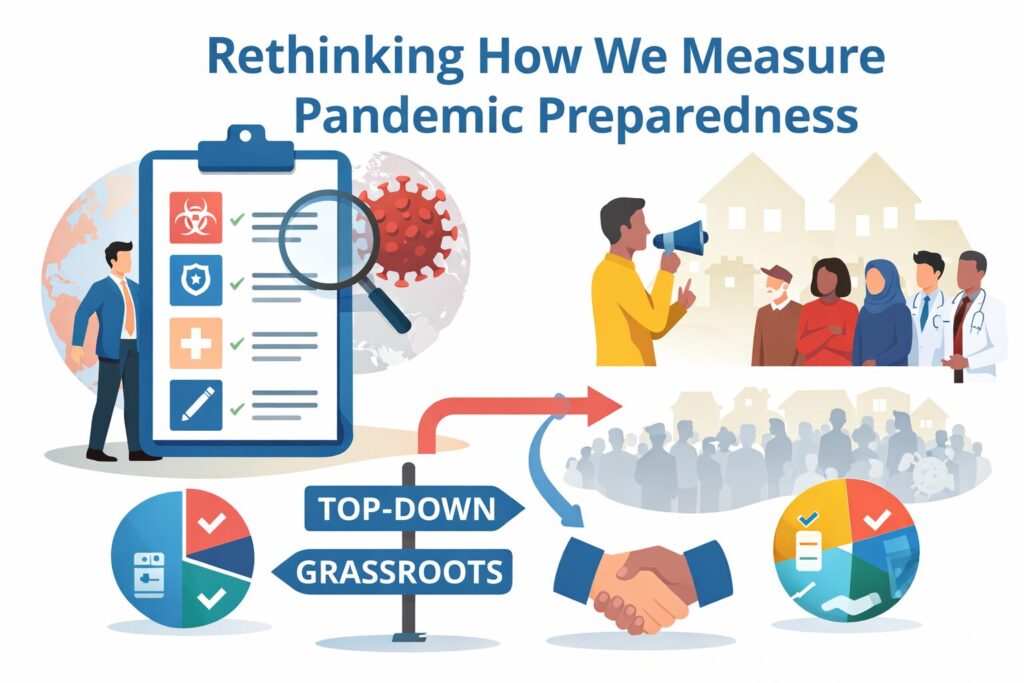
We need to rethink how we measure pandemic preparedness.
The COVID-19 pandemic exposed a striking gap between how preparedness was measured before the crisis and how countries actually performed during it. Our new systematic review argues that part of the problem lies in the indicators themselves.
🔑 Key takeaways:
• Top-down indicators miss what matters locally. Widely used global metrics often overlook factors such as trust, social cohesion, and community capacity—elements that proved crucial during COVID-19.
• Grassroots indicators add legitimacy and relevance. Evidence from multiple sectors shows that indicators co-produced with communities are more locally meaningful, strengthen accountability, and support implementation.
• Participation is not a “nice to have” in crises. In high-uncertainty settings like pandemics, combining expert knowledge with lived experience is essential for effective decision-making.
• A major gap remains in health security. Despite strong evidence from other fields, no existing studies have applied grassroots-inclusive indicators to pandemic preparedness—highlighting an urgent opportunity for innovation.
• Policy needs hybrid systems. The way forward is not replacing global indicators, but integrating bottom-up insights with top-down frameworks to improve both accuracy and trust.
Proud to share this work, led by Million Tesfaye Eshete, developed as background research for the NUS–Lancet Pandemic Readiness, Implementation, Monitoring, and Evaluation Commission, chaired by Helena Legido-Quigley and Helen Clark.
The full paper is available open access on the journal’s website.

Leave a Reply