
How does medical knowledge become care, and what happens to it along the way? In an interview published in the Italian newspaper Avvenire on 4 October 2026, Giovanni Scarafile talks with me about translational medical humanities and how language, culture and narrative shape medical evidence and practice. My thanks to Giovanni for a thoughtful conversation. Below are the original article and an English translation, drawing on my original responses.
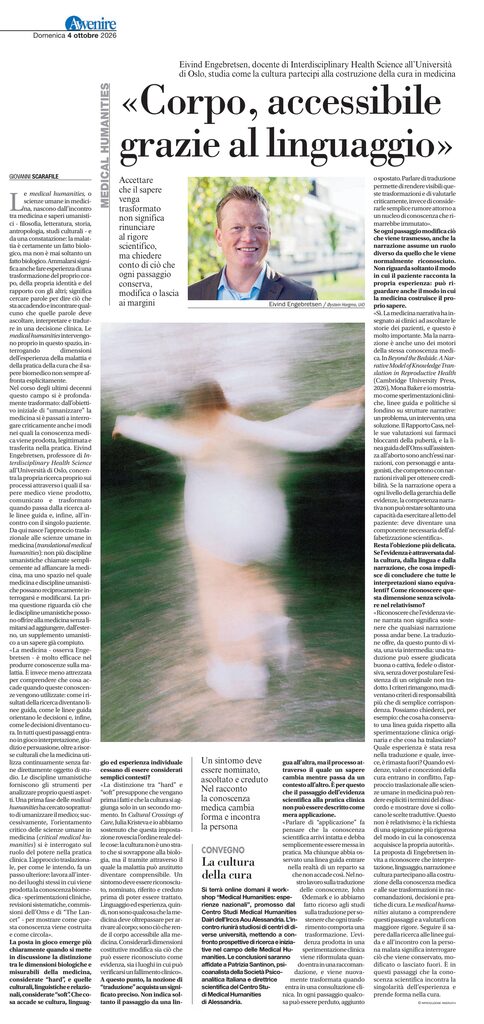
The body made accessible through language
Eivind Engebretsen, Professor of Interdisciplinary Health Science at the University of Oslo, explores how culture shapes medical care
By Giovanni Scarafile
Recognising that knowledge is transformed does not mean abandoning scientific rigour. It means asking what each stage preserves, changes or leaves out.
Medical humanities emerged from the encounter between medicine and disciplines such as philosophy, literature, history, anthropology and cultural studies, and from a simple observation: illness is a biological phenomenon, but never only a biological phenomenon. Becoming ill also changes our experience of our bodies, our sense of who we are and our relationships with others. It means searching for words to describe what is happening, and finding someone who can listen, interpret and translate those words into a clinical decision. This is where medical humanities comes in, examining aspects of illness and care that biomedical knowledge does not always explicitly address.
Over recent decades, the field has changed profoundly. Its initial ambition to “humanise” medicine has broadened into a critical examination of how medical knowledge itself is produced, legitimised and put into practice. Eivind Engebretsen, Professor of Interdisciplinary Health Science at the University of Oslo, studies precisely these processes: how medical knowledge is produced, communicated and transformed as it moves from research into guidelines and, ultimately, into the encounter with an individual patient.
This is the thinking behind translational medical humanities: an approach that brings medicine and the humanities into a space where they can question and reshape one another. The first question is what the humanities can offer medicine beyond an external supplement to a body of knowledge presumed to be complete.
“Medicine is very good at producing knowledge about disease,” Engebretsen observes. “It is much less good at accounting for what it does with that knowledge: how findings are turned into guidelines, how guidelines become decisions, how decisions become care. That work involves interpretation, judgement and persuasion, and it draws constantly on cultural resources medicine does not itself examine.
“The humanities offer the tools for that examination. The first wave of medical humanities tried to humanise the clinician; the critical wave asked what power does in the clinic. Translational medical humanities, as I understand it, goes a step further and works inside the genres of biomedical knowledge – trials, systematic reviews, WHO and Lancet commissions – to show how they are made and how they travel.”
The implications become clearer when we question the distinction between medicine’s biological, measurable dimensions, regarded as “hard”, and its cultural, linguistic and relational dimensions, regarded as “soft”. What changes when culture, language and individual experience are no longer treated as mere context?
“The ‘hard/soft’ split assumes facts come first and culture is added afterwards. Julia Kristeva and I argued in Cultural Crossings of Care that this gets it backwards: culture is not a layer on top of biology but the medium in which illness becomes intelligible at all. A symptom has to be recognised, named, reported and believed before it can be treated. Language and experience are therefore not what medicine steps over on its way to the body; they are what make the body available to medicine. Treating them as constitutive changes what counts as evidence and where clinical failure can occur.”
Here, “translation” takes on a specific meaning. It refers not simply to moving between languages, but to the way knowledge changes as it moves between contexts. This is why the passage from scientific evidence to clinical practice cannot be understood as mere application.
“‘Application’ implies knowledge arrives intact and is simply put to use. Anyone who has watched a guideline meet a ward knows otherwise. In our work on knowledge translation, John Ødemark and I have drawn on translation studies to argue that every transfer transforms.
“Evidence produced in a trial is rewritten when it enters a recommendation, and again when it enters a consultation. Something is always lost, added or displaced. Calling this translation makes those transformations visible and accountable, rather than treating them as noise around a stable core.”
If each stage changes what is being passed on, narrative also takes on a wider role than it is usually given. It concerns not only how patients describe their experiences, but how medicine constructs its own knowledge.
“Yes. Narrative medicine has taught clinicians to listen to patients’ stories, which is very important. But storytelling is also the engine of medical knowledge itself. In Beyond the Bedside: A Narrative Model of Knowledge Translation in Reproductive Health (Cambridge University Press, 2026), Mona Baker and I trace how trials, guidelines and policies rely on plots: a problem, an intervention, a resolution.
“The Cass Review on puberty blockers and the WHO guideline on abortion care are narratives, with characters and villains, that compete with rival narratives for credibility. If narrative operates at every level of the evidence hierarchy, narrative competence cannot remain a bedside skill but is a necessary part of scientific literacy.”
“If narrative operates at every level of the evidence hierarchy, narrative competence cannot remain a bedside skill but is a necessary part of scientific literacy.”
Eivind Engebretsen
This leaves a particularly difficult objection. If evidence is shaped by culture, language and narrative, what prevents us from treating all interpretations as equally valid? How can medicine acknowledge these dimensions without slipping into relativism?
“Acknowledging that evidence is narrated does not mean any story will do. Translation offers a middle path here: a translation can be judged good or bad, faithful or distorting, without positing an untranslated original.
“Criteria remain, but they are criteria of accountability rather than correspondence. What did this guideline preserve from the trial, and what did it drop? Whose experience was rendered, and whose was left untranslated?
“When evidence, values and conceptions of care conflict, translational medical humanities can make the terms of the disagreement explicit and show where the translation choices lie. That is not relativism; it is a demand for a more rigorous account of how knowledge earns its authority.”
Engebretsen’s approach asks us to recognise that interpretation, language, narrative and culture help shape medical knowledge and its transformation into recommendations, decisions and care. Medical humanities offers ways to understand these transformations and assess them more rigorously.
Following knowledge from research into guidelines and into the encounter with a person who is ill means asking what is preserved, what changes and what is left out. It is through these transitions that scientific knowledge meets the particularity of individual experience and takes shape as care.
The culture of care
The online workshop “Medical Humanities: National Experiences”, organised by the DAIRI Medical Humanities Study Centre at Alessandria University Hospital (IRCCS), will take place tomorrow. It will bring together scholars from centres at several universities to discuss their research perspectives and initiatives in medical humanities. Patrizia Santinon, a psychoanalyst with the Italian Psychoanalytic Society and scientific director of the Medical Humanities Study Centre in Alessandria, will deliver the closing remarks.
Leave a Reply